
2026’s First Nature Paper: Jilin University Team Makes Key Breakthrough in Electroluminescent Devices
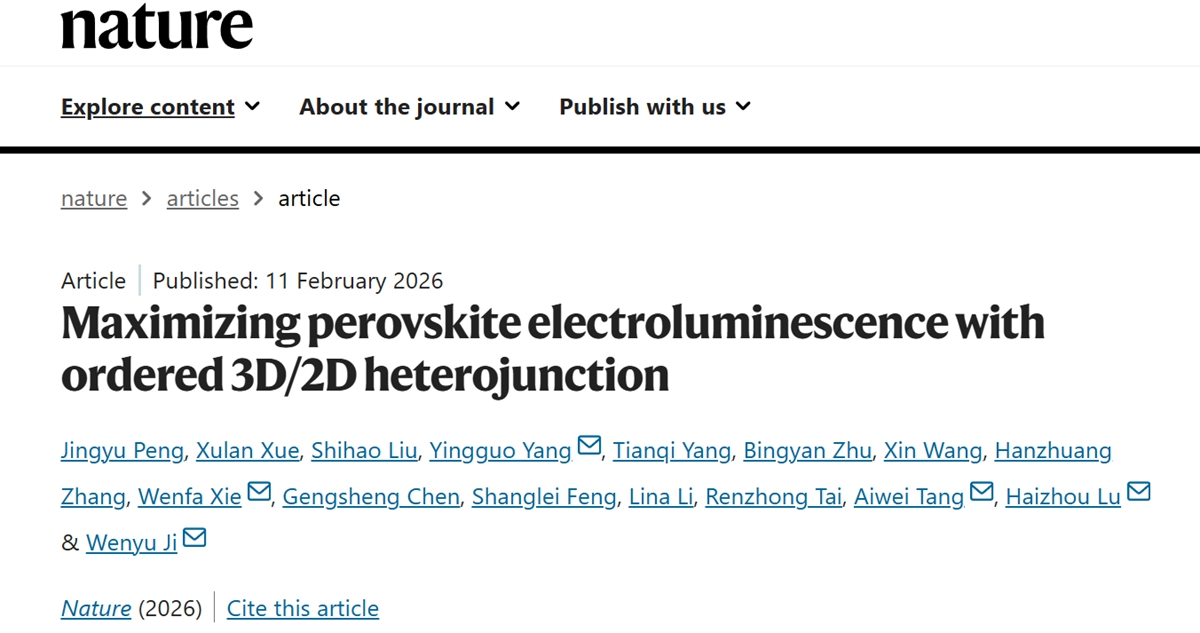
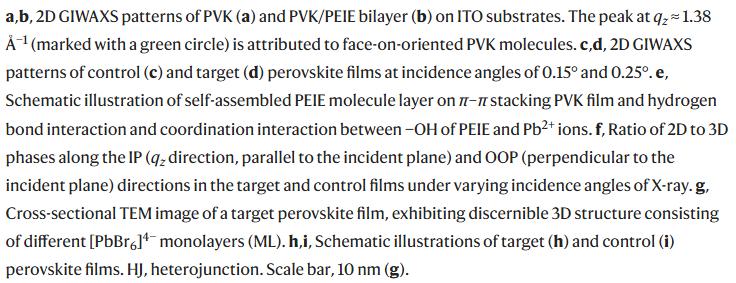
Recently, a research team led by Professors Ji Wenyu and Zhang Hanzhuang from the School of Physics at Jilin University, in partnership with Professor Xie Wenfa and Associate Professor Liu Shihao from the School of Electronic Science and Engineering, Professor Yang Yingguo from Fudan University, Professor Lu Haizhou from Southeast University, and Professor Tang Aiwei from Beijing Jiaotong University, reported major advances in improving luminescent interface and efficiency of perovskite light-emitting diodes (PeLEDs). The team reports a spontaneously formed 3D/2D vertically oriented perovskite heterojunction by means of a simple one-step spin-coating method. This structure effectively confines charge carriers and shifts the radiation zone away from the defect-rich surface region. The resulting PeLEDs achieved an EQE of 42.9% for the green emission (certified 42.3%), setting a new world record. The findings were published in Nature under the title “Maximizing perovskite electroluminescence with ordered 3D/2D heterojunction.”
Structural Innovation: From “Random Mixing” to “Ordered Assembly”
Metal halide perovskites have emerged as a material for LEDs owing to exceptional luminescent properties and cost-effective solution processability. Quasi-2D PeLEDs have demonstrated superior device performance and reproducibility because of their quantum well structures. However, quasi-2D perovskites are usually composed of hybrid and random 3D-2D phases and face two critical challenges: (1) abundant surface defects will lead to severe non-radiative recombination and (2) notable energy disorder will interrupt charge transport, hence reducing device efficiency.
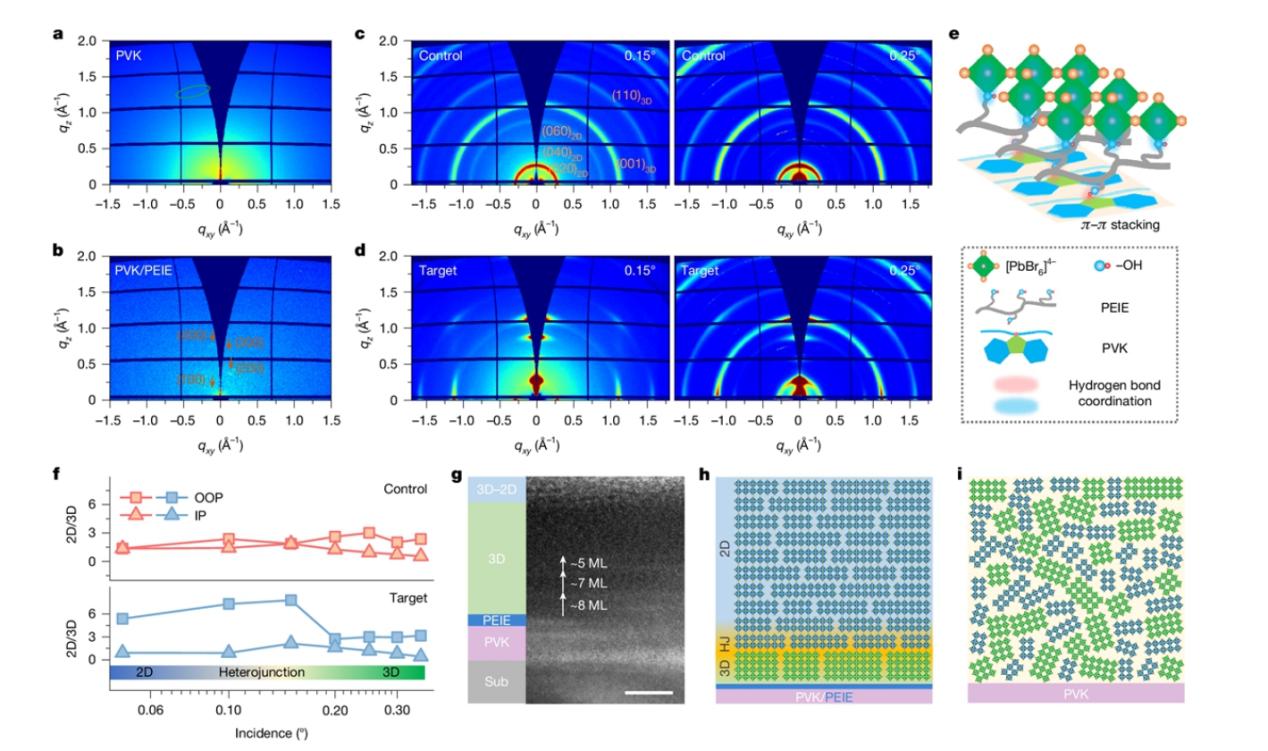
To overcome this challenge, the research team proposed a novel approach called “interface-induced crystallization”: introducing the hydroxyl-rich polymer PEIE onto the hole transport layer. This polymer can stably bond to the substrate via hydrogen bonds while coordinating with lead ions in the perovskite precursor through its hydroxyl groups, forming a high-density network of “molecular anchors”. This design enables bottom-up ordered growth: first inducing 3D perovskite to crystallize with horizontal orientation along the substrate, then spontaneously assembling a highly ordered 2D phase atop it, ultimately constructing a vertical gradient heterojunction with 3D perovskite below and 2D perovskite above.
Fig. 1: Characterization of perovskite heterojunctions.
Simultaneous improvement in device exciton formation efficiency and optical extraction efficiency
High Radiative Recombination and Exciton Confinement. This ordered gradient structure confines the device’s luminescent region to the 3D/2D perovskite interface, distancing excitons from surface defect-rich zones. This facilitates radiative recombination and enhances luminescence. The results clearly demonstrate PEIE’s pivotal role in inducing ordered perovskite heterostructures and boosting luminescent performance. The optimized perovskite thin film’s photoluminescence quantum efficiency (PLQE) increased from 85% to 97%.
Synergistic Light Extraction Enhancement. The introduction of long-chain organic molecules and the formation of low-dimensional perovskite phases endow perovskite films with a distinctive “wrinkled” surface morphology. This structure increases the effective light extraction pathways of the film, enabling the fabricated perovskite light-emitting devices to achieve a maximum light extraction efficiency of 45.4%.
Fig. 2: Device performance of PeLEDs.
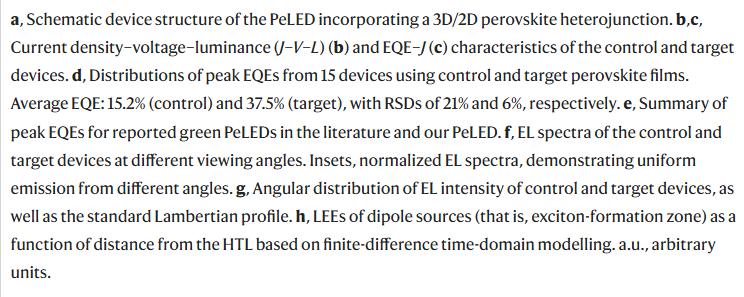
High-efficiency, low-cost, solution-processable Perovskite Light-Emitting Diodes (PeLEDs) are increasingly demonstrating their potential as next-generation display and lighting technologies. The breakthrough of this research lies not only in setting new efficiency records but also in the significant simplification of the fabrication process-achieving high-performance heterojunctions with a single spin-coating step, eliminating the need for complex post-processing. The 42.9% efficiency surpasses most commercial OLED levels, offering hope for perovskite applications in high-end displays (such as AR/VR and ultra-high-definition TVs) and solid-state lighting.
The primary institution for this paper is the School of Physics at Jilin University. The first author is Peng Jingyu, a doctoral student under Professor Ji Wenyu in the 2020 class of the Optics program. Co-first authors are Assistant Researcher Xue Xulan and Associate Professor Liu Shihao from the Changchun Institute of Optics, Fine Mechanics and Physics. Professor Ji Wenyu serves as the corresponding author. Professors Yang Yingguo, Tang Aiwei, Lu Haizhou, and Xie Wenfa are co-corresponding authors. This research was supported by Jilin University, the School of Physics at Jilin University, the Shanghai Synchrotron Radiation Facility (SSRF), a major national scientific facility, and the electron microscopy system at the Shanghai Institute of Applied Physics, Chinese Academy of Sciences (SIAP-CAS). Funding was provided by the National Natural Science Foundation of China (NSFC) and other projects. Throughout the research process, valuable guidance and constructive discussions were provided by Professor Bai Xue and Professor Zhang Yu from Jilin University, Professor Liu Yuhang from Xi’an Jiaotong University, and Dr. Yuan Zhongcheng from the University of Oxford.
Paper link: https://www.nature.com/articles/s41586-026-10134-1