
New Computational Paradigm for Spatial Multi-Omics: Significant Progress by Prof. Renchu Guan's Group
Recently, Professor Renchu Guan’s team from the College of Computer Science and Technology at Jilin University reported a major breakthrough in spatial multi-omics data analysis. The findings, titled "High-Parameter Spatial Multi-Omics through Histology-Anchored Integration," were published in the prestigious journal Nature Methods.
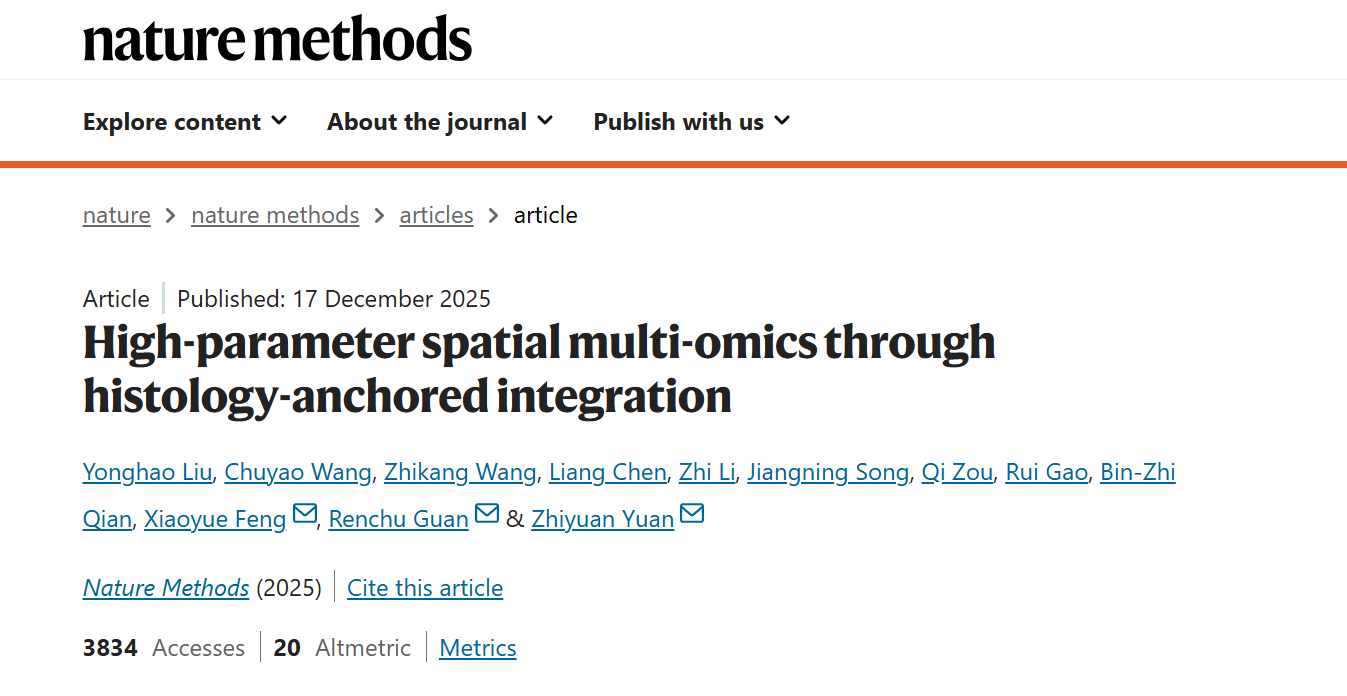
For decades, the scientific community has sought to simultaneously capture the precise spatial coordinates of cells alongside their comprehensive multi-omic profiles within the same tissue section. However, integrating multi-modal data across disparate sections remains a formidable challenge. This study pioneeringly defines and addresses the critical bottleneck of 'spatial diagonal integration' in spatial multi-omics—specifically, the challenge of co-registering and normalizing heterogeneous data with non-overlapping molecular features across distinct tissue sections and technology platforms.
To address this challenge, the team developed 'SpatialEx,' an advanced AI computational framework. By innovatively synergizing histology image foundation models with hypergraph neural networks, SpatialEx learns complex cross-section, cross-platform, and multi-modal mapping relationships, enabling the high-fidelity computational construction of multidimensional spatial multi-omics atlases. The profound impact of this method lies in its ability to reconstruct high-dimensional molecular landscapes—traditionally requiring cost-prohibitive and labor-intensive experiments—directly from routine, readily accessible H&E-stained histological sections. This breakthrough overcomes the information-density bottlenecks of current single-omics technologies, providing a robust and universal computational engine for the next generation of biomedical discovery.
In breast cancer studies, SpatialEx demonstrated superior discriminatory power over existing methods, not only constructing a comprehensive 'whole-slide view' of tissue architecture but also pinpointing subtle nuances within the immune microenvironment that are often imperceptible even to expert pathologists. Furthermore, in a Parkinson’s disease model, the integration of metabolomic and transcriptomic data through SpatialEx unveiled coordinated molecular patterns of dopamine-related genes and metabolites within lesioned brain regions, providing a multi-dimensional lens into complex disease mechanisms. These findings underscore the transformative potential of this framework to accelerate the integration of spatial multi-omics into precision medicine, therapeutic development, and next-generation clinical diagnostics.
This study was a collaborative effort led by the College of Computer Science and Technology at Jilin University in partnership with Fudan University. The co-first authors of the paper are Yonghao Liu (Jilin University), Chuyao Wang (Jilin University), and Zhikang Wang (a joint PhD student at Monash University and Fudan University). The corresponding authors are Professor Renchu Guan and Professor Xiaoyue Feng from Jilin University, alongside Associate Professor Zhiyuan Yuan from Fudan University. For more details, the full paper is available at: https://www.nature.com/articles/s41592-025-02926-6.
Paper link: https://www.nature.com/articles/s41592-025-02926-6